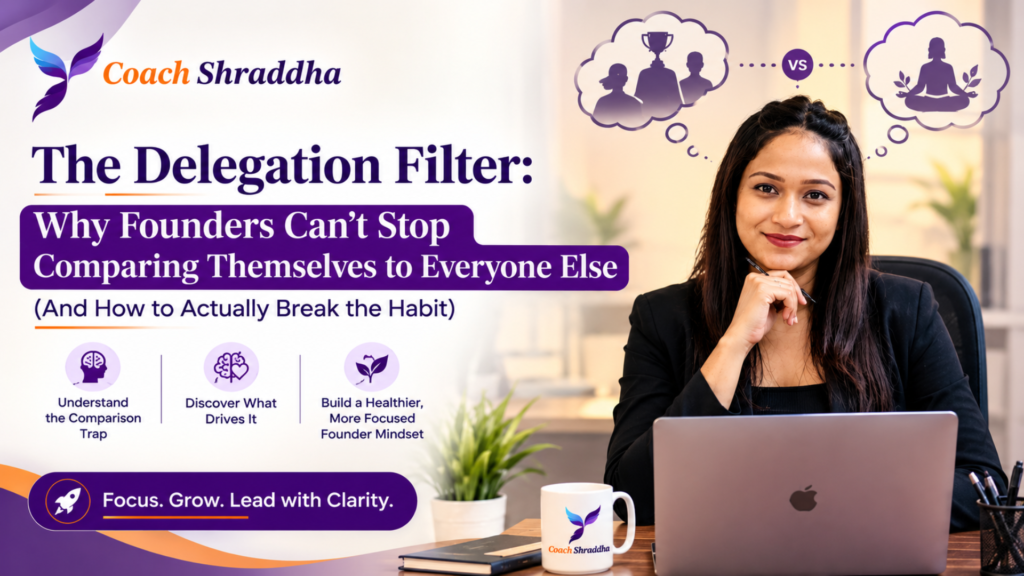
Almost every founder I coach does this, whether they say it out loud or not: they open LinkedIn or Instagram, see another founder’s funding announcement, their “we just crossed 7 figures” post, their team photo from an offsite that looks nothing like the chaos of your own week and something in them quietly deflates.
It’s not envy exactly. It’s more like a private, running scoreboard that never stops updating, where you’re always somehow behind. And the strange part is, this doesn’t get better as the business grows. Founders who are genuinely doing well still do this. Success doesn’t switch it off. It just changes who they’re comparing themselves to next.
If you recognize this in yourself, here’s what’s actually going on, and what genuinely helps.
You’re Comparing Your Whole Story to Someone Else’s Highlight Reel
The most basic problem with comparison, and the one that’s easiest to know intellectually and still fail to actually believe, is this: what you’re seeing on someone else’s feed is not their life. It’s the chapter they chose to publish.
You see the funding announcement. You don’t see the eighteen months of rejected pitches before it. You see the “we hit our best month ever” post. You don’t see the three brutal months before that, the co-founder fight, the moment they weren’t sure the business would survive. Every founder online is running a highlight reel, curated and edited, and you’re standing next to it with your entire unedited story — the doubts, the slow weeks, the decisions you’re still not sure about.
That’s not a fair comparison. It was never going to be. You’re measuring your full, messy, real experience against someone else’s single best-lit photograph, and losing every time, because that’s structurally how this comparison is built to work.
Knowing this intellectually doesn’t make the feeling go away on its own. But it does explain why the feeling is so persistent and so unreliable — you’re not actually learning anything true about where you stand. You’re just reacting to an incomplete picture, over and over.
The Instinct to Compare Never Fully Disappears — But What You Compare Against Can Change
Here’s the part that might be the most useful thing in this whole piece: comparison is not a habit you’re going to eliminate entirely. It’s wired into how humans evaluate their own standing — you compare because that’s one of the ways the brain tries to figure out if it’s doing okay. Expecting it to just stop is setting yourself up to feel like you’re failing at managing your own mind, on top of everything else you’re already carrying.
What actually changes for founders who get better at this isn’t that the instinct disappears. It’s that they redirect what the instinct is measuring against. The comparison itself doesn’t need to go away — the target of it does.
The One Question That Actually Shifts This
The next time you catch yourself sliding into comparison scrolling, feeling that familiar drop in your chest — there’s one question that reliably interrupts it: Where am I compared to where I was last month?
Not compared to the founder who just raised a Series A. Not compared to the version of the business you imagined when you started, three years and a hundred pivots ago. Compared to yourself, thirty days back.
This question works because it’s the only comparison you actually have complete, honest information about. You know exactly where you were a month ago. You don’t actually know where the founder on your feed really is — you only know what they chose to show you. So this is the one measuring stick that isn’t rigged from the start, and it’s the one that actually tells you something true.
Ask it consistently enough, and it starts to replace the reflex to check yourself against everyone else’s outside. Not because you’ve forced yourself to stop caring what other people are doing, but because you’ve given your brain a more useful, more accurate target to measure against instead.
Comparison Often Hits Hardest in the Quiet Moments, Not the Big Ones
There’s a specific pattern worth naming here: comparison rarely does its worst damage in a big, obvious moment. It’s not usually the funding announcement itself that wrecks a founder’s week. It’s the quiet ten minutes of scrolling before bed, or the gap between meetings when you check your phone out of habit and land on someone else’s win with no context and no defenses up.
Those small, unguarded moments are where comparison does its real work, precisely because you’re not braced for it. You’re not in “founder mode” evaluating information critically — you’re just tired, scrolling, and suddenly measuring your entire messy week against someone’s single polished announcement.
This is worth knowing because it means the fix isn’t really about having a clever comeback ready for the big triggering moments. It’s about noticing the small, low-guard moments where comparison sneaks in unannounced, and building the habit of catching it there, before it has a chance to quietly set the tone for your whole day.
This Is What Real Progress Actually Looks Like
There’s something founders forget in the middle of comparing themselves to everyone else’s race: you were never running theirs. You’re on your own pace, in your own journey, with your own constraints, your own starting point, your own version of what building this thing actually costs you.
If you spend your energy trying to win someone else’s race, there is no version of that where you actually get to win — because the finish line was never yours. It belongs to them, built around their timeline, their resources, their market, their specific version of what “ahead” means. You can sprint as hard as you want toward a line that was never drawn for you, and all that gets you is exhausted, and further from the actual progress happening in your own business, which you weren’t paying attention to because you were busy watching someone else’s.
The founders who build something sustainable, who are still standing in three years and five years, aren’t the ones who never compared themselves to anyone. They’re the ones who learned to catch it quickly, redirect it back to their own trajectory, and keep their attention on the only race that was ever actually theirs to run.
What This Actually Requires
None of this happens automatically just from reading it. It requires catching yourself in the moment, consistently, which is genuinely hard to do alone — because comparison usually happens fast, quietly, in a scroll that takes four seconds, long before you’ve had time to consciously redirect it.
This is exactly the kind of pattern that’s much easier to interrupt with someone outside your own head helping you see it — someone who can point out when you’re measuring yourself against the wrong thing, before it quietly costs you weeks of confidence and momentum you didn’t need to lose.
If this is a pattern you recognize in yourself, that’s worth an actual conversation.
Book a free Discovery Call, and let’s work on getting your focus back on your own race.