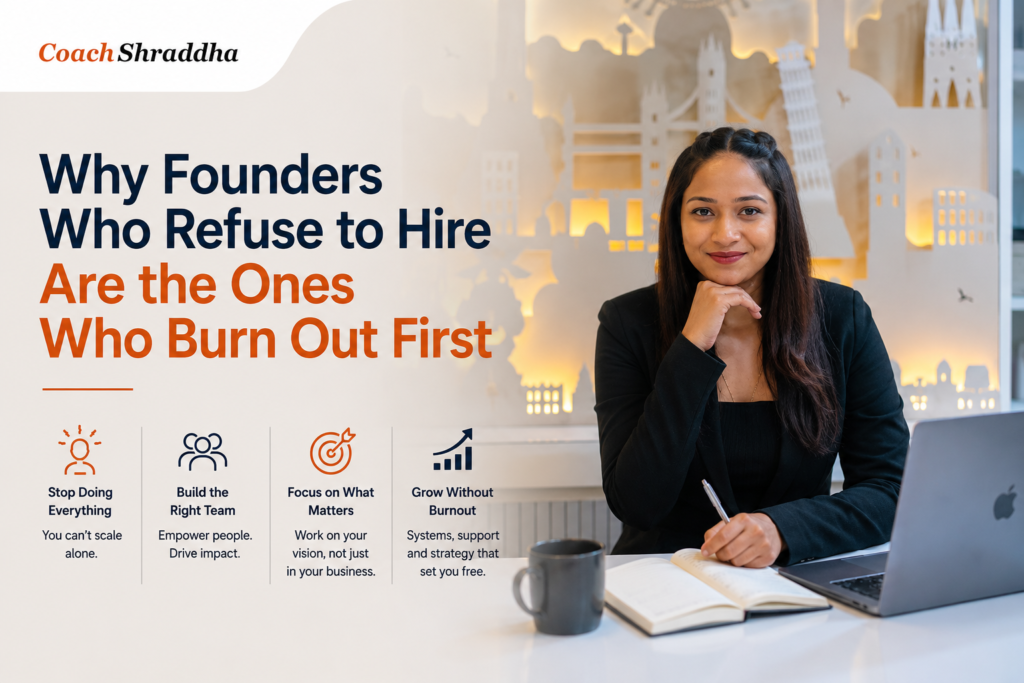
There’s a specific kind of founder I meet constantly, and I understand exactly why they exist.
They’re doing the accounting themselves at midnight. Writing every piece of content. Handling every client call, every hire, every operational fire, every strategic decision. They haven’t brought in a coach, a mentor, or built out a real team, because every one of those things costs money the business “can’t spare yet.”
On paper, it looks like discipline. It looks like a founder being careful with resources, bootstrapping the right way, not wasting money on things they can technically do themselves.
In practice, it’s usually the single most expensive decision they’re making, they just can’t see the bill yet, because it isn’t arriving as a bill. It’s arriving as burnout, slow decisions, missed opportunities, and a business that has quietly stopped growing because it’s capped at exactly what one exhausted person can carry.
The Cost You Can See vs. The Cost You Can’t
Hiring a coach, a mentor, or your first real team member has a cost you can see immediately, a number on an invoice. That’s precisely why it feels like the easy thing to cut. It’s visible, it’s optional-seeming, and the business appears to survive without it, at least for a while.
The cost of not hiring is much larger, but it’s invisible, which is exactly why founders underestimate it so consistently.
It’s the deal you lost because you were too stretched to respond in time. It’s the good hire who left within three months because you had no time to onboard or manage them properly, so you’re now paying to recruit and train all over again. It’s the strategic mistake you made because you had no one to sanity-check your thinking, that a single conversation with an experienced mentor would have caught in ten minutes. It’s the eighteen months you spent solving a problem the hard way that an expert could have shown you how to solve in a fraction of the time.
None of that shows up as a line item. All of it shows up in your growth rate, your health, and how close you are to quitting on your worst weeks.
Why I’ll Do It Myself Feels Safer
This isn’t really about founders not understanding math. It’s psychological, and it’s worth naming honestly.
Doing everything yourself feels like control, and control feels like safety. Hiring someone, a coach, a mentor, a team member, means trusting someone else with something that matters to you, and trust feels riskier than just gripping it tighter yourself.
There’s also identity wrapped up in it. A lot of founders take quiet pride in being the person who built this alone, who didn’t need help, who figured it out through sheer will. That pride is real and it’s earned. It’s also exactly what keeps some founders stuck two or three years past the point where “figuring it out alone” stopped being an asset and started being the ceiling on their own business.
The Mentor and Coach Gap Specifically
Of everything founders skip to save money, coaching and mentorship tend to get cut first, because the return isn’t as immediately tangible as hiring an employee who produces visible output.
But a good mentor or coach isn’t a luxury add-on, they’re the fastest way to skip years of expensive trial and error. They’ve already made the mistakes you’re about to make. They can see blind spots in your thinking that you structurally cannot see yourself, because you’re inside the business and they’re not. They shorten your learning curve on exactly the decisions where a wrong call costs you the most, hiring, pricing, positioning, leadership, when to push and when to hold.
Founders who invest in this early consistently make fewer expensive mistakes than founders who wait until they’re already deep in a crisis to look for outside help. By the time the crisis arrives, you’re not investing in growth anymore, you’re paying for damage control, and it usually costs more than the mentorship would have.
What Doing It All Yourself Actually Costs Your Business
Set the personal burnout aside for a moment and look at just the business impact of a founder who won’t hire or build a team.
Every decision routes through one person, which means the business can only move as fast as that one person’s bandwidth allows, and bandwidth doesn’t scale, no matter how disciplined or hardworking the founder is. Opportunities that require quick action get missed because the founder is buried in something operational that someone else could have handled. And the founder’s own strategic thinking, the highest-value work only they can actually do, gets crowded out by low-value tasks they’re doing purely to avoid the cost of hiring for them.
A business capped by one person’s hours is not actually a lean, efficient business. It’s a business with an invisible ceiling that gets more expensive to break through the longer it’s ignored.
The Point Where It Usually Breaks
There’s typically a moment where this pattern stops being sustainable, and it rarely announces itself in advance. It’s not usually one catastrophic event. It’s more often an accumulation, a founder who’s been running on adrenaline for two years, hits a health scare, a burnout episode, or simply a week where they physically cannot keep up the pace anymore, and the business, which was never built to run without them, starts showing every crack at once.
At that point, founders often do end up hiring, a coach, an operations person, a first real leadership hire. But they’re doing it from a position of crisis instead of strategy, which means decisions get made faster and worse than they would have if the same hire had happened eighteen months earlier, calmly, as part of a plan.
The founders who avoid this particular cliff aren’t the ones who never needed help. Every founder needs help eventually, the business is too complex for one person to hold indefinitely, no matter how capable they are. The founders who avoid the cliff are the ones who brought in support before the crisis forced their hand, while they still had the bandwidth to onboard people properly and the clarity to make good decisions about who and what they actually needed.
The Real Question to Ask
It’s not “can I afford to hire a team, a coach, or a mentor right now?”
It’s “what is it actually costing me, in missed opportunities, in slow decisions, in exhaustion, in mistakes I’m repeating that someone experienced could have helped me avoid, to keep doing this alone?”
Once founders actually sit down and calculate that second number honestly, the first one usually stops looking so scary.
This is exactly the gap Elevate YOU is built to close, two days with founders and business owners who are done carrying everything solo, working directly with facilitators who’ve been through this exact stage, to build the systems, delegation, and support structures that let you finally stop being the bottleneck in your own business.
The founding cohort runs 22–23 August in Jaipur, capped at 20 founders, with early bird pricing of ₹14,999 for the first 10 applicants.
Shraddha is an ICF & Mindvalley Certified Coach and ProTouch Certified Leadership Trainer based in India. She works with founders and leaders navigating growth, team dynamics, and the personal side of professional leadership.